Finding who is ready now
The hiring-signal account check
A list you already trust to the accounts on it that are hiring, and a verified person to call.
By Mike Hurley, founder of WarmUp. We ran this on our own list in September 2026.
Version 1.0. Last updated . About 6 minutes.
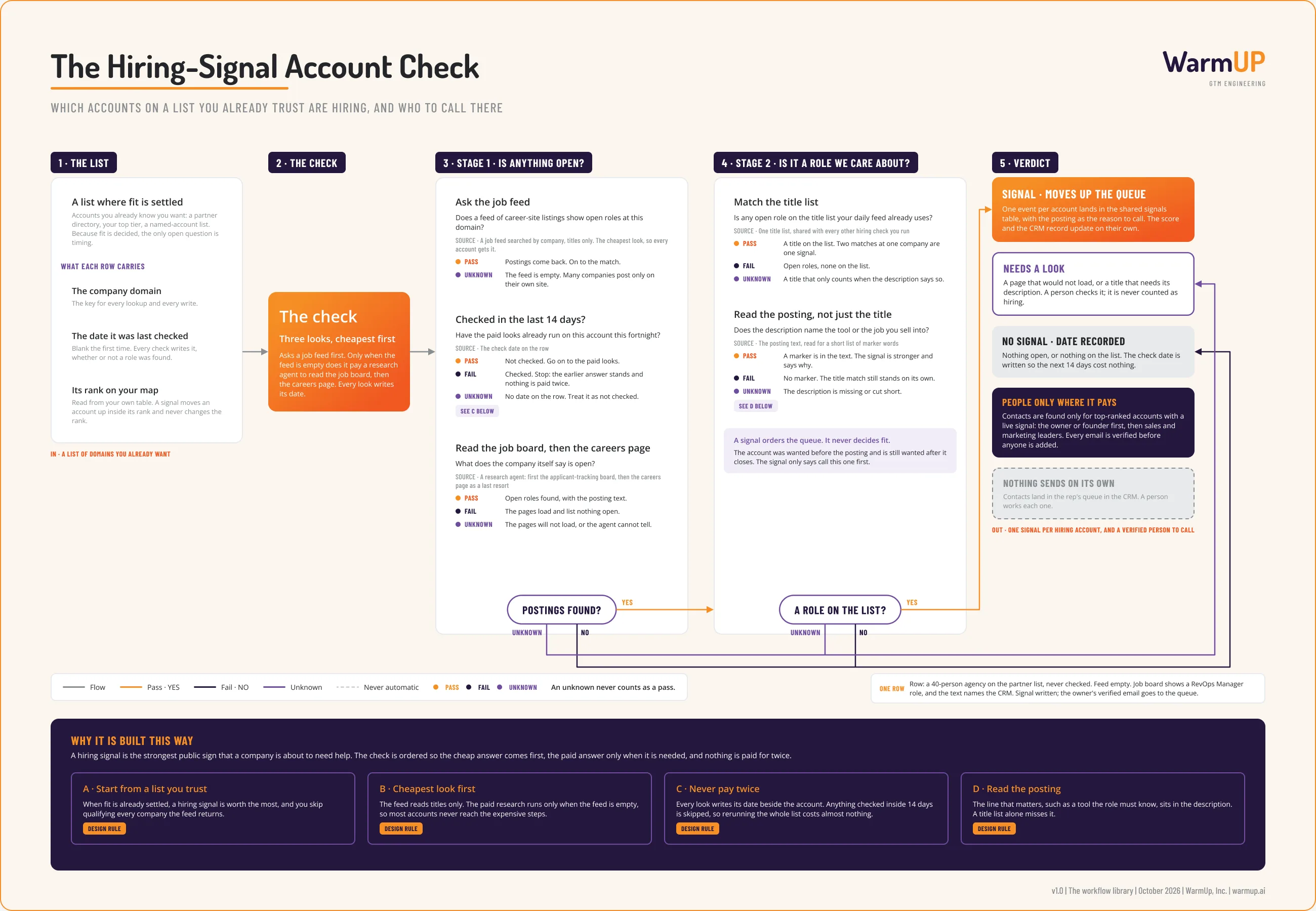
Left to right, following the numbers: the list, the check, Stage 1 (is anything open?), Stage 2 (is it a role we care about?), the verdict. The strip under the legend follows one account through. Open the board to see it full size.
Why it helps
The hiring signal feed starts from job postings and asks whether each company is one we want. This check runs the other way. It starts from a list of companies we already want and asks which of them are hiring. When fit is settled, the only open question is timing, and a job posting is the best public answer to it.
Our list was 802 partner agencies of the CRM we build in. On the first run, 67 of them were hiring for a role on our title list, five of those postings named a tool we work in, and the check ended with 71 verified contacts at 39 agencies in the rep's queue. The other 735 agencies were checked once, and for the next 14 days checking them again costs nothing.
One thing to know before you copy it: a job feed alone misses companies that post only on their own site, and small companies often do. That is why there are three looks and not one.
Why we built it this way
- Start from a list you trust. A signal is worth the most where fit is already decided, and you skip qualifying every company a feed returns.
- Cheapest look first. The job feed reads titles only and is the cheapest thing in the workflow, so every account gets it. The paid research runs only when the feed comes back empty.
- Never pay twice. Every look writes its date and what it cost beside the account, whether or not a role was found. Anything checked inside 14 days is skipped, so you can rerun the whole list as often as you like.
- Read the posting, not just the title. The line that matters, such as a tool the role must know, sits in the description. The order of the three looks came from a design the team at Freckle shared with us. We rebuilt it as our own.
- One title list for every hiring check. This check and the daily feed read the same file, so a title means the same thing in both.
- A signal orders the queue and never decides fit. A hiring account moves up inside its rank. Its rank does not change.
- People only where it pays. Contacts are found only for top-ranked accounts with a live signal, the owner or founder first. Every email is verified before anyone is added, and nobody is messaged automatically.
How to build it
- Pick a list where fit is settled. A partner directory, your top tier, a named-account list. Key it on company domain and add two columns: the date last checked and what the check cost.
- Skip anything checked in the last 14 days. Do this before any look runs.
- Look one: ask a job feed by company domain, titles only. If postings come back, go straight to the match.
- Look two, only when the feed is empty. A research agent finds the company's applicant-tracking board and reads what is open.
- Look three, the last resort. The agent reads the careers page the way a person would. If the pages will not load, the answer is unknown, and a person takes a look.
- Match the postings to your title list. Then read each matching description for your marker words. Two matching roles at one company are one signal.
- Write one signal event per hiring account. To the same signals table your other workflows use, with the posting as the reason to call. Let your scoring pick it up from there.
- Find people only for the accounts that earned it. Top-ranked, with a live signal. Owner or founder first, then sales and marketing leaders. Verify the email, then put the contact in the rep's queue for a person to work.
Copy this
The fallback order and the people rule
# account-check.yaml
list:      accounts where fit is already decided, keyed on company domain
skip_if:   checked_at is within 14 days            # never pay twice
looks:     # in order; stop at the first one that returns postings
  1: job feed by company domain, titles only                  # cheapest, every account
  2: research agent reads the applicant-tracking board        # paid, only when 1 is empty
  3: research agent reads the careers page                    # paid, last resort
  unreadable: unknown -> a person looks; never counted as hiring
match:     the same title list your daily hiring feed reads
read_description_for: [the tools you work in, the job you sell into]
write:
  always:   checked_at, what each look cost
  on_match: one signal event per account (title, posting URL, marker found: yes | no)
people:
  only_when: the account is in your top two ranks AND has a live signal
  order:     [owner or founder, sales leader, marketing leader]
  require:   a verified email
  land_in:   the rep's queue, as a contact a person works
never:     [a message sent automatically, a rank changed by a signal]
The same guide as plain Markdown, for an agent or a notes app: /library/hiring-signal-account-check.md
Words we use
- Signal:
- Something a company or a person did that suggests now is a good time to talk: a job posting, a comment on a post, a form, a reply.
- Tier:
- The rank a company holds on the map because of its fit. A signal moves a company up inside its tier and never changes the tier.
- Queue:
- The one ordered list a rep works from, with a score and a reason to call beside each name.
- Unknown:
- The answer a check gives when it cannot tell. An unknown is never counted as a pass. It waits for a person or for a missing fact.
The full build guide
The same guide with the board at full size, kept on our Notion site with the rest of the library.
Open the build guide →Want this run on your named accounts?
We build it, run it with you, and hand it over, with an engineer who can keep it running. Or hire that engineer directly.
30 minutes to scope it. Engagements are contracted through WarmUp, Inc.