Finding who is ready now
The social listening play
LinkedIn engagers to a message written per person. Every morning.
By Mike Hurley, founder of WarmUp. This runs our own pipeline. It is not a demo build.
Version 1.3. Last updated . About 8 minutes.
- Motion
- Outbound
- Channel
- Steps
- 8
The social listening play: the route
In order: the eight authors, the routine, stage 1 (protect, then the six facts), stage 2 (route, then write), the verdict. An orange arrow is a yes. Two more lines carry every no to Not sent and every unknown to Held. Each card is drawn in full beside the step it explains under "How to build it". Go to the stages in detail
Eight authors
Every morning, five steps in order
The routine
Blacklist, watcher, gate, handoff, writer
Stage 1: protect, then the six facts
Passes the six facts?
- Yes: On to stage 2.
- Unknown: Held, unknown after one look-up.
- No: Not sent, on record with a reason.
Stage 2: route, then write
Checks pass?
- Yes: On the campaign list, written.
- Unknown: Held, unknown after one look-up.
- No: Not sent, on record with a reason.
- Signal flow
- Pass, yes
- Fail, no: not sent
- Unknown: held
Fail closed: an unknown never counts as a pass.
- Signal flow
- Pass, yes
- Fail, no: not sent
- Unknown: held
- Fail closed: an unknown never counts as a pass.
- In:
- Eight author URLs, a date floor, the never-message list.
- Out:
- A person on a campaign list with two messages written and checked; nothing sent by code.
Download the boardOpen it full sizeOne sheet, free to keep and share.
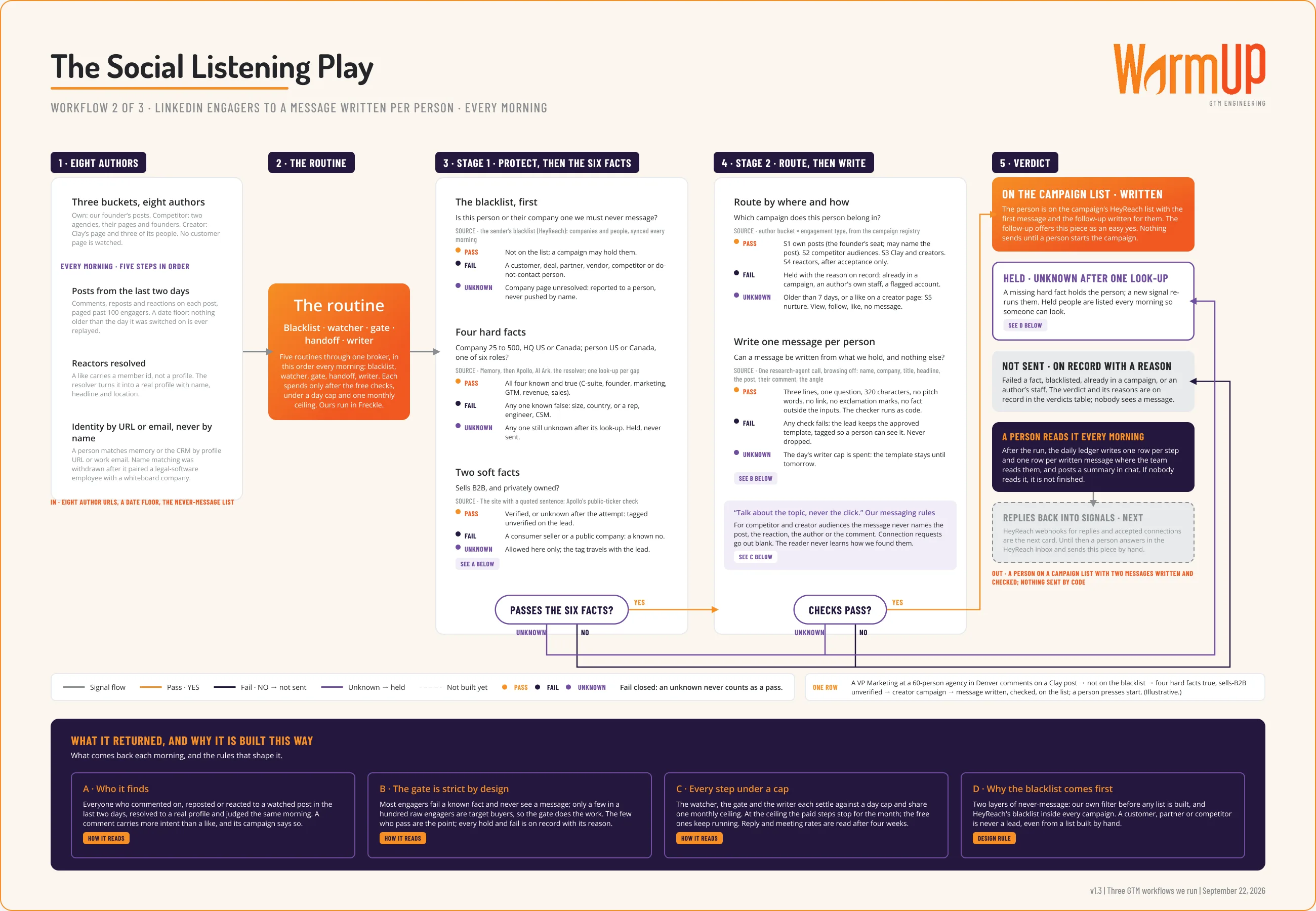
Why it helps
People who comment on, repost or react to a post about GTM engineering are telling you what is on their mind this week. Every morning the play collects them from eight authors (my own posts, two competitors, and Clay's people), checks six facts about each person and their company, blocks anyone we must never message, and writes a first message and a follow-up for each person who passes. Most engagers fail a known fact and never see a message. Someone on the team reads the first batch and starts each campaign by hand. Nothing sends on its own.
Spend is set in advance: one monthly ceiling for the whole play and a day cap for each step. When the ceiling is reached the paid steps stop for the month and the free ones keep running. Most of the six facts come from memory or sources with no provider credits, so the paid look-up is the exception, whichever tool answers it.
Why we built it this way
- The blocklist comes before the watcher. Every customer, open deal, partner, vendor, competitor and do-not-contact person is on the sender's blocklist before a single lead is added, and our own filter runs on top. A list built by hand cannot leak either.
- Four of the six facts must be known. Two may be unverified. Company size, HQ country, the person's country and the person's role must be known and true. Whether they sell to businesses, and whether they are privately owned, may pass unverified after one attempt, with a tag that stays on the lead so any send can be traced back.
- A person is matched by profile URL or work email, never by name. On the first live run, name matching paired an employee of a legal-software company with a whiteboard company. We withdrew the rule the same day.
- The message talks about the topic and never mentions the click. For competitor and creator audiences it never names the post, the reaction or the author. Connection requests go out blank.
- Code checks every draft before a person sees it. Three sentences, one question, 320 characters, no pitch words, no link, no exclamation mark, no fact that is not in the inputs. A draft that fails keeps the approved template, with a tag, and is never dropped.
- A person starts every campaign. After reading its first batch. And a person reads the ledger every morning after that.
How to build it
- Choose the authors and set a date floor. One file: each author's URL, their bucket (own, competitor, creator), the staff domains to exclude, and the copy rule (direct for your own posts, topic only for everyone else). Nothing before the floor is ever replayed.
Three buckets, eight authors
Own: our founder's posts. Competitor: two agencies, their pages and founders. Creator: Clay's page and three of its people. No customer page is watched.
In: Eight author URLs, a date floor, the never-message list. - Build the never-message list before the watcher. Customers, open deals, partners, vendors, competitors, do-not-contact people. Push it to your sender's blocklist and keep your own copy as a second filter.
The blacklist, first
Is this person or their company one we must never message?
Source: the sender's blacklist (HeyReach): companies and people, synced every morning
- Pass
- Not on the list; a campaign may hold them.
- Fail
- A customer, deal, partner, vendor, competitor or do-not-contact person.
- Unknown
- Company page unresolved: reported to a person, never pushed by name.
- Watch the posts. Two days back. Comments, reposts and reactions. Page past the first hundred. A reaction carries a member id, not a profile, so resolve it to one. Land every engagement in the signals table with the post text and the comment text.
Posts from the last two days
Comments, reposts and reactions on each post, paged past 100 engagers. A date floor: nothing older than the day it was switched on is ever replayed.
Reactors resolved
A like carries a member id, not a profile. The resolver turns it into a real profile with name, headline and location.
Identity by URL or email, never by name
A person matches memory or the CRM by profile URL or work email. Name matching was withdrawn after it paired a legal-software employee with a whiteboard company.
- Judge one person per run, cheapest source first. Memory, then sources with no provider credits, then one paid look-up per missing fact. The four hard facts hold the person on unknown. The two soft facts may pass with a tag. Write the verdict, the facts and every attempt down.
Four hard facts
Company 25 to 500, HQ US or Canada; person US or Canada, one of six roles?
Source: Memory, then Apollo, AI Ark, the resolver; one look-up per gap
- Pass
- All four known and true (C-suite, founder, marketing, GTM, revenue, sales).
- Fail
- Any one known false: size, country, or a rep, engineer, CSM.
- Unknown
- Any one still unknown after its look-up. Held, never sent.
Two soft facts
Sells B2B, and privately owned?
Source: The site with a quoted sentence; Apollo's public-ticker check
- Pass
- Verified, or unknown after the attempt: tagged unverified on the lead.
- Fail
- A consumer seller or a public company: a known no.
- Unknown
- Allowed here only; the tag travels with the lead.
- Passes the six facts?
- Yes:On to stage 2.
- Unknown:Held, unknown after one look-up.
- No:Not sent, on record with a reason.
- Route by author bucket and engagement type. To a standing campaign per audience: your own posts, competitor audiences, creator audiences, reactors (after they accept), and a nurture lane with no message.
Route by where and how
Which campaign does this person belong in?
Older than 7 days, or a like on a creator page: S5 nurture. View, follow, like, no message.
Source: author bucket × engagement type, from the campaign registry
- Pass
- S1 own posts (the founder's seat; may name the post). S2 competitor audiences. S3 Clay and creators. S4 reactors, after acceptance only.
- Fail
- With the reason on record: already in a campaign, an author's own staff, a flagged account.
- Write per person, then check by code. One research call with browsing off, given only what you hold on the person, the post and the comment. Run the checker on the output. On any failure, keep the template.
Write one message per person
Can a message be written from what we hold, and nothing else?
Source: One research-agent call, browsing off: name, company, title, headline, the post, their comment, the angle
- Pass
- Three lines, one question, 320 characters, no pitch words, no link, no exclamation marks, no fact outside the inputs. The checker runs as code.
- Fail
- Any check fails: the lead keeps the approved template, tagged so a person can see it. Never dropped.
- Unknown
- The day's writer cap is spent: the template stays until tomorrow.
"Talk about the topic, never the click."
Our messaging rules
For competitor and creator audiences the message never names the post, the reaction, the author or the comment. Connection requests go out blank. The reader never learns how we found them.
- Checks pass?
- Yes:On the campaign list, written.
- Unknown:Held, unknown after one look-up.
- No:Not sent, on record with a reason.
- Never start a campaign from code. Create every campaign as a draft. A person reads the first batch and presses start in the app. Replies are answered by a person.
Verdict
On the campaign list, written
The person is on the campaign's HeyReach list with the first message and the follow-up written for them. The follow-up offers this piece as an easy yes. Nothing sends until a person starts the campaign.
Held, unknown after one look-up
A missing hard fact holds the person; a new signal re-runs them. Held people are listed every morning so someone can look.
Not sent, on record with a reason
Failed a fact, blacklisted, already in a campaign, or an author's staff. The verdict and its reasons are on record in the verdicts table; nobody sees a message.
A person reads it every morning
After the run, the daily ledger writes one row per step and one row per written message where the team reads them, and posts a summary in chat. If nobody reads it, it is not finished.
Replies back into signals, next
Not built yet
HeyReach webhooks for replies and accepted connections are the next card. Until then a person answers in the HeyReach inbox and sends this piece by hand.
Out: A person on a campaign list with two messages written and checked; nothing sent by code. - Run the five steps as one routine. In order: blocklist, watcher, gate, handoff, writer. A cap per step, a monthly ceiling shared by all of them, and a ledger someone reads.
One row
- A VP Marketing at a 60-person agency in Denver comments on a Clay post
- not on the blacklist
- four hard facts true, sells-B2B unverified
- creator campaign
- message written, checked, on the list; a person presses start
What it returned, and why it is built this way
What comes back each morning, and the rules that shape it.
Copy this
The six facts and the message checker
# the six facts (hard = must be known and true; soft = may pass unverified after one attempt)
[hard]  the company has 25 to 500 employees
[hard]  the company's HQ is in the US or Canada
[hard]  the person lives in the US or Canada
[hard]  the person is a founder, C-suite, or a marketing, GTM, revenue or sales leader
[soft]  the company sells to businesses (a quoted sentence from its own site, or "unverified")
[soft]  the company is privately owned
sources, cheapest first: your own tables -> the CRM -> previews with no provider credits -> one paid look-up per missing fact

# the message checker (a draft that fails any line keeps the template)
first message:  at most 3 sentences, 320 characters, 1 or 2 question marks
follow-up:      at most 4 sentences, 400 characters, exactly 1 question mark
never:          an exclamation mark, a URL, or "book", "demo", "pricing", "offer", "call" in the first message
never (competitor and creator audiences): "saw you", "noticed you", "your comment", "liked", "your post", the author's name
never:          a company name, number or product that is not in the inputs
The same guide as plain Markdown, for an agent or a notes app: /library/social-listening-play.md
This guide is the build. What we run when the signal fires, with the first line of the call, what waits for your yes and what you keep, is a signal play with its own page. See the signal play: A reaction to your post
Words we use
- Signal:
- Something a company or a person did that gives a reason to reach out now: a job posting, a funding round, a visit to your site, a click on an ad, a contract award, a compliance date, an expansion, a comment on a post, a form, a reply.
- Blocklist:
- The companies and people we must never contact. One tool writes it, and every sender reads the same copy.
- Sender:
- A tool that delivers messages or calls on one channel: email, LinkedIn or the phone.
- Cap:
- A spending limit per day or per month. Over the cap, the routine stops and says so.
- Ledger:
- The place the receipts are read. One row per run, read by a person every morning.
- Unknown:
- The answer a check gives when it cannot tell. An unknown is never counted as a pass. It waits for a person or for a missing fact.
Want the play running on your authors and your sender?
We build it in your tools and run it with your team.
30 minutes to scope it. Engagements are contracted through WarmUp, Inc.