Finding who is ready now
The hiring signal feed
Job postings to qualified accounts in the CRM. Four runs a morning.
By Mike Hurley, founder of WarmUp. This runs our own pipeline. It is not a demo build.
Version 1.3. Last updated . About 7 minutes.
- Motion
- Outbound
- Channel
- CRM
- Steps
- 8
- Tools
- Apify, Freckle
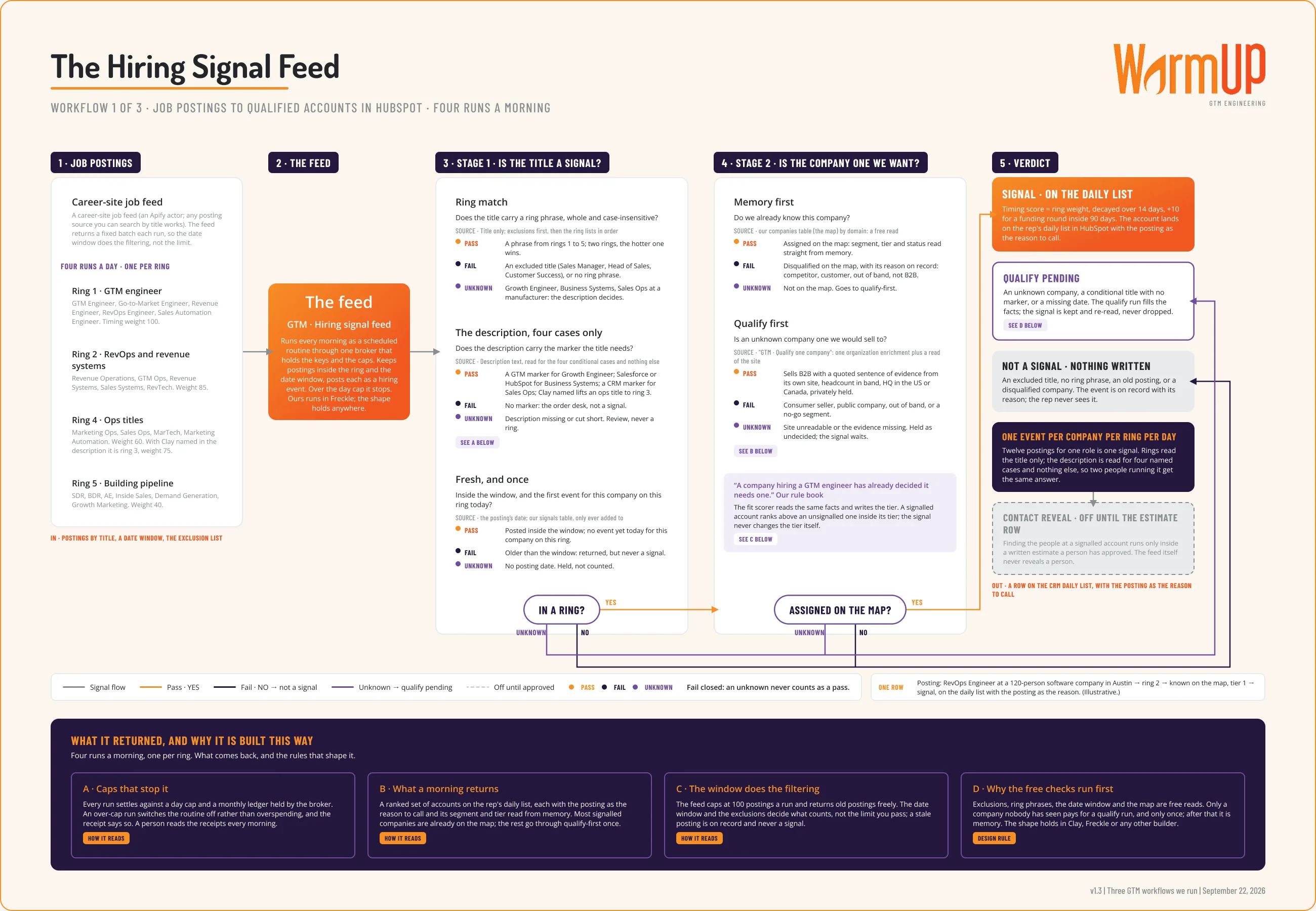
The hiring signal feed: the route
In order: the job postings and the five rings, the feed, Stage 1 (is the title a signal?), Stage 2 (is the company one we want?), the verdict. An orange arrow is a yes; every no ends at Not a signal and every unknown at Qualify pending. Each stage is drawn in full beside its step under "How to build it". Go to the stages in detail
Job postings
Four runs a day, one per ring
- Ring 1, GTM engineer
- Ring 2, RevOps and revenue systems
- Ring 4, ops titles (ring 3 with Clay named)
- Ring 5, building pipeline
The feed
GTM · Hiring signal feed
Stage 1, is the title a signal?
- Ring match
- The description, four cases only
- Fresh, and once
In a ring?
- Yes: On to Stage 2.
- Unknown: Qualify pending.
- No: Not a signal, nothing written.
Stage 2, is the company one we want?
- Memory first
- Qualify first
Assigned on the map?
- Yes: Signal, on the daily list.
- Unknown: Qualify pending.
- No: Not a signal, nothing written.
- VerdictSignal, on the daily list
- Signal flow
- Pass, yes
- Fail, no: not a signal
- Unknown: qualify pending
Fail closed: an unknown never counts as a pass.
- Signal flow
- Pass, yes
- Fail, no: not a signal
- Unknown: qualify pending
- Fail closed: an unknown never counts as a pass.
- In:
- Postings by title, a date window, the exclusion list.
- The feed:
- Runs every morning as a scheduled routine through one broker that holds the keys and the caps. Keeps postings inside the ring and the date window, posts each as a hiring event. Over the day cap it stops. Ours runs in Freckle; the shape holds anywhere. Tools we used: Freckle.
- Out:
- A row on the CRM daily list, with the posting as the reason to call.
Download the boardOpen it full sizeOne sheet, free to keep and share.
Why it helps
A company that posts a job for a GTM engineer or a RevOps lead has already decided it needs one. That is the clearest buying signal I know of, and it is public. The feed turns each posting into a ranked account on the rep's daily list the same morning, with the posting itself as the reason to call. Most of the companies it finds are already on our map with a segment and a tier, so the rep opens the list and sees who to call first and why.
The other half is what it does not spend. The only paid step is a research call on a company nobody has looked at before, and it runs once per company. Every run counts against a day cap and a monthly total. If a run would go over, the routine stops, and the receipt says why.
Why we built it this way
- The rings read the title and nothing else. Five lists of whole phrases, each with a weight. The description is read for four named cases only, so two people running the feed get the same answer, and changing a rule is a one-line edit.
- Exclusions run before the rings. Sales Manager, Head of Sales and Customer Success are never a signal, whatever else the title says. It is the cheapest check, so it goes first.
- Twelve postings for one role are one signal. One event per company, per ring, per day. The signals table is only ever added to, never edited, so a receipt from last month still reads true today.
- A known company is a free read. Only a company we have never seen pays for a qualify run, and its answer goes onto the map so the run never repeats.
- An unknown is never a pass. A conditional title with no marker in the description, or a posting with no date, waits for a person to look at it.
- The broker holds the cap, so the workflow cannot ignore it. A day cap and a monthly total. Over the cap the routine stops. It does not overspend and explain later.
How to build it
- Write the rings down first. One file: five title lists with a weight each (ours are 100, 85, 75, 60 and 40), the exclusion list, and the four description cases with the words that decide them. Every other step reads this file.
- Pick a posting source you can search by title. We use a career-site job feed on Apify, run through Freckle, one run per ring with a date window. The source returns a fixed batch each run and mixes in old postings, so the date window does the filtering, not the limit you pass.
Career-site job feed
A career-site job feed (an Apify actor; any posting source you can search by title works). The feed returns a fixed batch each run, so the date window does the filtering, not the limit.
Four runs a day, one per ring
Ring 1, GTM engineer
GTM Engineer, Go-to-Market Engineer, Revenue Engineer, RevOps Engineer, Sales Automation Engineer. Timing weight 100.
Ring 2, RevOps and revenue systems
Revenue Operations, GTM Ops, Revenue Systems, Sales Systems, RevTech. Weight 85.
Ring 4, ops titles (ring 3 with Clay named)
Marketing Ops, Sales Ops, MarTech, Marketing Automation. Weight 60. With Clay named in the description it is ring 3, weight 75.
Ring 5, building pipeline
SDR, BDR, AE, Inside Sales, Demand Generation, Growth Marketing. Weight 40.
In: Postings by title, a date window, the exclusion list. Tools we used: An Apify actor, run through Freckle. - Land every posting in a signals table you only add to. Key it on company domain, ring and posting date. Refuse a second event for the same company and ring on the same day.
Ring match
Does the title carry a ring phrase, whole and case-insensitive?
Source: Title only; exclusions first, then the ring lists in order
- Pass
- A phrase from rings 1 to 5; two rings, the hotter one wins.
- Fail
- An excluded title (Sales Manager, Head of Sales, Customer Success), or no ring phrase.
- Unknown
- Growth Engineer, Business Systems, Sales Ops at a manufacturer: the description decides.
The description, four cases only
Does the description carry the marker the title needs?
Source: Description text, read for the four conditional cases and nothing else
- Pass
- A GTM marker for Growth Engineer; Salesforce or HubSpot for Business Systems; a CRM marker for Sales Ops; Clay named lifts an ops title to ring 3.
- Fail
- No marker: the order desk, not a signal.
- Unknown
- Description missing or cut short. Review, never a ring.
Fresh, and once
Inside the window, and the first event for this company on this ring today?
Source: The posting's date; our signals table, only ever added to
- Pass
- Posted inside the window; no event yet today for this company on this ring.
- Fail
- Older than the window: returned, but never a signal.
- Unknown
- No posting date. Held, not counted.
- In a ring?
- Yes:On to Stage 2.
- Unknown:Qualify pending.
- No:Not a signal, nothing written.
Tools we used: The rings file and our signals table. - Look the domain up on your map before you spend anything. Known: read its segment, tier and status. Unknown: send it to a qualify workflow that reads the company's own site and fills a fixed set of fields, with a quoted sentence as evidence. Write the answer back to the map.
Memory first
Do we already know this company?
Source: Our companies table (the map) by domain: a free read
- Pass
- Assigned on the map: segment, tier and status read straight from memory.
- Fail
- Disqualified on the map, with its reason on record: competitor, customer, out of band, not B2B.
- Unknown
- Not on the map. Goes to qualify-first.
Qualify first
Is an unknown company one we would sell to?
Source: "GTM · Qualify one company": one organization enrichment plus a read of the site
- Pass
- Sells B2B with a quoted sentence of evidence from its own site, headcount in band, HQ in the US or Canada, privately held.
- Fail
- Consumer seller, public company, out of band, or a no-go segment.
- Unknown
- Site unreadable or the evidence missing. Held as undecided; the signal waits.
“A company hiring a GTM engineer has already decided it needs one.”
Our rule book
The fit scorer reads the same facts and writes the tier. A signalled account ranks above an unsignalled one inside its tier; the signal never changes the tier itself.
- Assigned on the map?
- Yes:Signal, on the daily list.
- Unknown:Qualify pending.
- No:Not a signal, nothing written.
Tools we used: Our companies table (the map) and the "GTM · Qualify one company" workflow. - Score how recent the signal is. Fit already lives on the account. The timing score is the ring's weight, fading over 14 days, plus 10 for a funding round in the last 90 days. A signal moves an account up inside its tier and never changes the tier.
- Push a daily list to the CRM. With the posting as the reason to call. Keep it short enough to work through in a morning.
Verdict
Signal, on the daily list
Timing score = ring weight, decayed over 14 days, +10 for a funding round inside 90 days. The account lands on the rep's daily list in HubSpot with the posting as the reason to call.
Qualify pending
An unknown company, a conditional title with no marker, or a missing date. The qualify run fills the facts; the signal is kept and re-read, never dropped.
Not a signal, nothing written
An excluded title, no ring phrase, an old posting, or a disqualified company. The event is on record with its reason; the rep never sees it.
One event per company per ring per day
Twelve postings for one role is one signal. Rings read the title only; the description is read for four named cases and nothing else, so two people running it get the same answer.
Contact reveal, off until the estimate row
Off until approved
Finding the people at a signalled account runs only inside a written estimate a person has approved. The feed itself never reveals a person.
Out: A row on the CRM daily list, with the posting as the reason to call. Tools we used: HubSpot holds the rep's daily list. - Run it as a scheduled routine in the cloud. Through one broker that holds the keys and the caps. No cron on a laptop. Give it a day cap and a switch that turns it off.
- Give it a reader. One ledger row per run (postings seen, events written, companies qualified, spend) and one short message in a channel someone reads every morning. If nobody reads it, it is not finished.
One row
- Posting: RevOps Engineer at a 120-person software company in Austin
- known on the map, tier 1
- signal, on the daily list with the posting as the reason
What it returned, and why it is built this way
Four runs a morning, one per ring. What comes back, and the rules that shape it.
- ACaps that stop it
- Every run settles against a day cap and a monthly ledger held by the broker. An over-cap run switches the routine off rather than overspending, and the receipt says so. A person reads the receipts every morning. (How it reads.)
- BWhat a morning returns
- A ranked set of accounts on the rep's daily list, each with the posting as the reason to call and its segment and tier read from memory. Most signalled companies are already on the map; the rest go through qualify-first once. (How it reads.)
- CThe window does the filtering
- The feed caps at 100 postings a run and returns old postings freely. The date window and the exclusions decide what counts, not the limit you pass; a stale posting is on record and never a signal. (How it reads.)
- DWhy the free checks run first
- Exclusions, ring phrases, the date window and the map are free reads. Only a company nobody has seen pays for a qualify run, and only once; after that it is memory. The shape holds in Clay, Freckle or any other builder. (Design rule.)
Copy this
The rings file
The one file the feed reads for its rules. Ours, trimmed to a few titles per ring. The full lists are longer but the shape is this.
# rings.yaml: the only rules the hiring feed reads
exclusions: [Sales Manager, Head of Sales, Customer Success]     # never a signal, any ring
rings:
  - {ring: 1, weight: 100, titles: [GTM Engineer, Go-to-Market Engineer, RevOps Engineer, Revenue Engineer, Sales Automation Engineer]}
  - {ring: 2, weight: 85,  titles: [Revenue Operations, RevOps, GTM Operations, Revenue Systems, Sales Systems, RevTech]}
  - {ring: 3, weight: 75,  titles: ["any ring-4 title whose description names Clay"]}
  - {ring: 4, weight: 60,  titles: [Marketing Operations, Sales Operations, MarTech, Marketing Automation]}
  - {ring: 5, weight: 40,  titles: [SDR, BDR, Account Executive, Inside Sales, Demand Generation, Growth Marketing]}
conditional:   # the only four cases where the description is read at all
  - {title: Growth Engineer,   counts_as: ring 1, only_when: a GTM marker, vetoed_by: a product-led marker}
  - {title: Business Systems,  counts_as: ring 2, only_when: the description names Salesforce or HubSpot}
  - {title: any ring-4 title,  counts_as: ring 3, only_when: the description names Clay}
  - {title: Sales Operations at a manufacturer or agency, counts_as: ring 4, only_when: a CRM marker, otherwise: the order desk, not a signal}
markers:
  gtm:         [Clay, HubSpot, Salesforce, outbound, lead routing, enrichment, CRM, sequencing]
  product_led: [A/B test, experimentation, activation, retention, product analytics]
  crm:         [CRM, HubSpot, Salesforce, pipeline, forecasting, automation]
timing: {decay_days: 14, funding_bonus: 10, funding_window_days: 90}
one_event_per: [company, ring, day]
The same guide as plain Markdown, for an agent or a notes app: /library/hiring-signal-feed.md
This guide is the build. What we run when the signal fires, with the first line of the call, what waits for your yes and what you keep, is a signal play with its own page. See the signal play: Hiring for the role you sell to
Words we use
- Ring:
- A list of job titles that count as the same signal, with a weight. Ring 1 is the strongest.
- Signal:
- Something a company or a person did that gives a reason to reach out now: a job posting, a funding round, a visit to your site, a click on an ad, a contract award, a compliance date, an expansion, a comment on a post, a form, a reply.
- Fit and timing:
- Two separate numbers. Fit is how well a company matches who we sell to, and it belongs to the account. Timing is how fresh the signal is, and it fades.
- The map:
- One table of companies, keyed on domain, with a status, a segment, a tier and a reason for each. Nothing is deleted from it. A status changes when a fact does.
- Broker:
- One small service that holds the API keys and the spending caps, so a routine cannot spend past them.
- Cap:
- A spending limit per day or per month. Over the cap, the routine stops and says so.
- Receipt:
- The written record of a run: what it checked, what it decided, what it spent.
Want the feed watching your titles by next month?
We build it in your tools and run it with your team.
30 minutes to scope it. Engagements are contracted through WarmUp, Inc.